

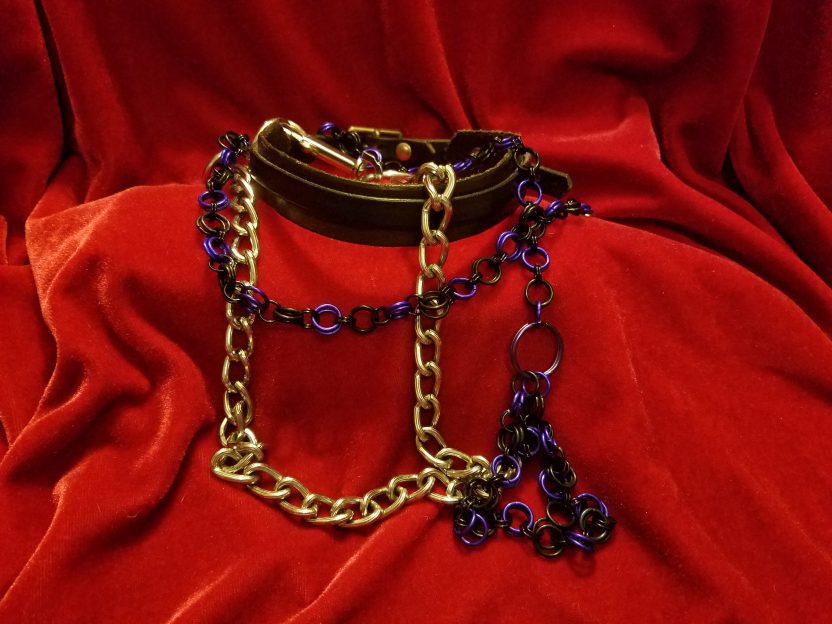
This seems like a pretty basic question on the surface, but when you dive deep, you find it’s a lot more complex. And, as with many things in the Scene, the meaning depends on the people involved.
Simply put, a collar is usually defined as a band that you wear around your throat. It can be made from almost any material: lace, leather, metal, velvet. And by itself it doesn’t need to have any sort of meaning.
Collars are a popular fashion accessory. You can buy them at Claire’s and many other stores, and simply wear them because they are cute. Every so often their popularity will surge, and you’ll see tons of teenage girls walking around with collars around their necks… so, to be clear, that has nothing to do with kink or BDSM.
It doesn’t matter if it’s a green ribbon, a black velvet band, or even a chain with a lock—it does not automatically signify that the person wearing it is in the Scene. Please do not assume that anyone wearing a collar is into BDSM.
However, the definition of a collar in the BDSM world is a little different. For one thing, it might not be worn around the neck, and it might not resemble a ‘collar’ at all.
In the kink world, dynamics who use them, often don’t make it obvious, except when in designated Scene places. It might look like a plain necklace. It might be a bracelet. Anklets in particular have been popular on and off.
This kind of collar means that the symbol of the relationship can be worn freely in public without raising any eyebrows. Collars that are obviously collars can be problematic in some situations. They also might need to be taken off for work, whereas a necklace or anklet can be worn all the time.
My first collar was an anklet for this reason. It was made by a silversmith friend, and couldn’t be removed without tools. It was convenient because I could wear it all the time and it was never in the way. At the time I worked in healthcare, so any other jewelry was a problem. The fact that it was rarely seen by anyone else didn’t matter.
So does wearing a collar in the BDSM world always have deeper meaning? No, not always.
Again, people can wear them as a fashion accessory. It might go with your favorite kink outfit. I have a dozen collars of various materials (chains, leather, or velvet) that I bought myself and simply wear when I feel like it. And if I wore one to a club it might be a nod to my submission, or it might just be because I feel more confident wearing them.
This is not hanky code. You cannot see someone wearing a collar and think it tells you anything about them.
It cannot tell you if they are ‘taken’.
It cannot tell you if they are submissive.
It may hint at those things, but no assumptions can be made just from the presence of a collar.
Subs wear collars. Versatiles wear collars. Single people wear collars. Taken people wear collars. Dominants can also wear collars.
You will experience excruciating embarrassment if you try to treat a Dominant like a submissive, simply because they have a collar around their neck. Trust me.
A collar can have zero meaning. Or… it can mean everything. It all depends on the situation and people involved. You will need to use your communication skills, if you want to find out anything definite.
Saying you are ‘collared’ on the other hand… is very different.
When a submissive says they are ‘collared’ it doesn’t mean they are wearing a collar. They are telling you that they are ‘owned’, ‘claimed’, or in a committed D/s dynamic with a Dominant.
You may have heard of things such as a protective collar, a training collar, a mentor collar, or a collar of consideration. All of these are used for specific reasons and can sometimes be part of temporary situations.
They can be used for trial periods to see if the dynamic will work for both sides. They can be used when a submissive is accepted for training, perhaps to learn a specific skill, before moving on. They can be used simply as a symbol that the submissive is under someone’s protection, possibly until they find a permanent Dominant.
These situations can be less about emotional connection, and more about declaring an arrangement to the public. It can be a warning to predators to stay away. It can be a warning that the submissive is new and is still learning. There are many reasons for that kind of collar.
Regardless, these collars are still real and meaningful in their own way and should be taken seriously, even if they are for a limited time.
But for couples who have been together in a D/s relationship for a while, and want to make things more formal, collaring can be a culmination of that relationship. To kinky people a collar, in this situation, can be as meaningful as a wedding ring.
They might plan a collaring ceremony to celebrate this, either private, or with friends who would understand the gravity of the event. It can be very formal, or simply a small meaningful moment between two people.
The decision to collar someone, or accept a collar, should always be done with careful consideration. It’s not something to jump into. I would be wary of a Dom who rushed too quickly to collar someone they barely knew.
But this is referring to a true collaring with meaning and commitment, and not just wearing a collar.
This doesn’t mean a Dom won’t want to put a collar around your neck for a night at the club, or that they won’t give you one to wear on their command at certain times, or whenever you are together. In this use the collar is more a symbol of submission, rather than a permanent commitment.
And collars that have meaning, and are given as part of a formal D/s dynamic, are usually quite different from decorative collars. Most likely it won’t be a cheap leather band or choke chain, but something a little more elegant, but it depends on personal taste.
They might be permanent, such as an eternity collar. It might be impossible to remove without help, and tools, which symbolizes a permanent commitment. And again, it might not look like a collar at all.
When a submissive is collared formally in a committed relationship, it’s not uncommon for them to be given a collar that can be worn everywhere in public, that way it doesn’t need to be taken off. As I mentioned above, bracelets, necklaces, and anklets are common.
And dynamics might have multiple collars for different situations. An everyday collar that is not obvious (or is, because they don’t care who knows) and decorative collars for kink events or during scenes.
In case it’s not obvious… being ‘collared’ is not about the physical symbol of the relationship. It is about the commitment. A physical collar isn’t actually required at all, though most dynamics do use them.
I will add one last thing. Some people in the Scene believe that a submissive should have to earn the collar. Collaring comes after the submissive has proven themselves, perhaps passed tests. This is to prove they are ‘ready’ to be collared.
If that works for you… then enjoy. I can see the usefulness of this in a training situation with someone who is new to submission, or perhaps when preparing for a TPE (Total Power Exchange) dynamic, which can be incredibly intense.
But I struggle with a dynamic where only one side has to prove they’re ready for commitment. Especially since, and this is a generalization, the Dom being ‘unready’ can cause a lot more damage in my experience.
A submissive not being ready to be collared usually just ends with them chafing at the restrictions, and breaking things off. It’s too much. It’s too intense. They change their minds.
A Dom not being ready to have a collared submissive can lead to a whole host of issues. A Dominant is taking on the responsibility for another person. They are being handed a lot of power and control over someone’s life, but no one expects them to ‘earn’ or ‘prove’ their worthiness to put a collar around that person’s neck.
And in most situations, it’s the Dom who decides when it’s time for a collar, so that’s… a bit of a problem.
I think, and again this is just my opinion, that a collaring should occur when both sides are sure they are ready. This should involve a lot of introspection and then a lot of conversation, to make sure everyone knows what the expectations are. I would expect the same from people who think they are ready to get engaged or married.
 Musings of a Chaotic Mind
Thank you for sharing your insights! An excellent call-out about the uneven nature of the perceived “worthiness” of Dominants versus submissives and how this can play out in collaring.
LikeLiked by 1 person
Honestly, it’s something that has bothered me for a while. There are plenty of submissives who enjoy the training aspect and having to earn the collar, and that’s fine but I think we need to be clear that it’s about enjoying the feeling of earning something. And not that Doms are instantly worthy while subs have to prove they are good enough.
LikeLiked by 1 person